 SPROKFIELD NOTES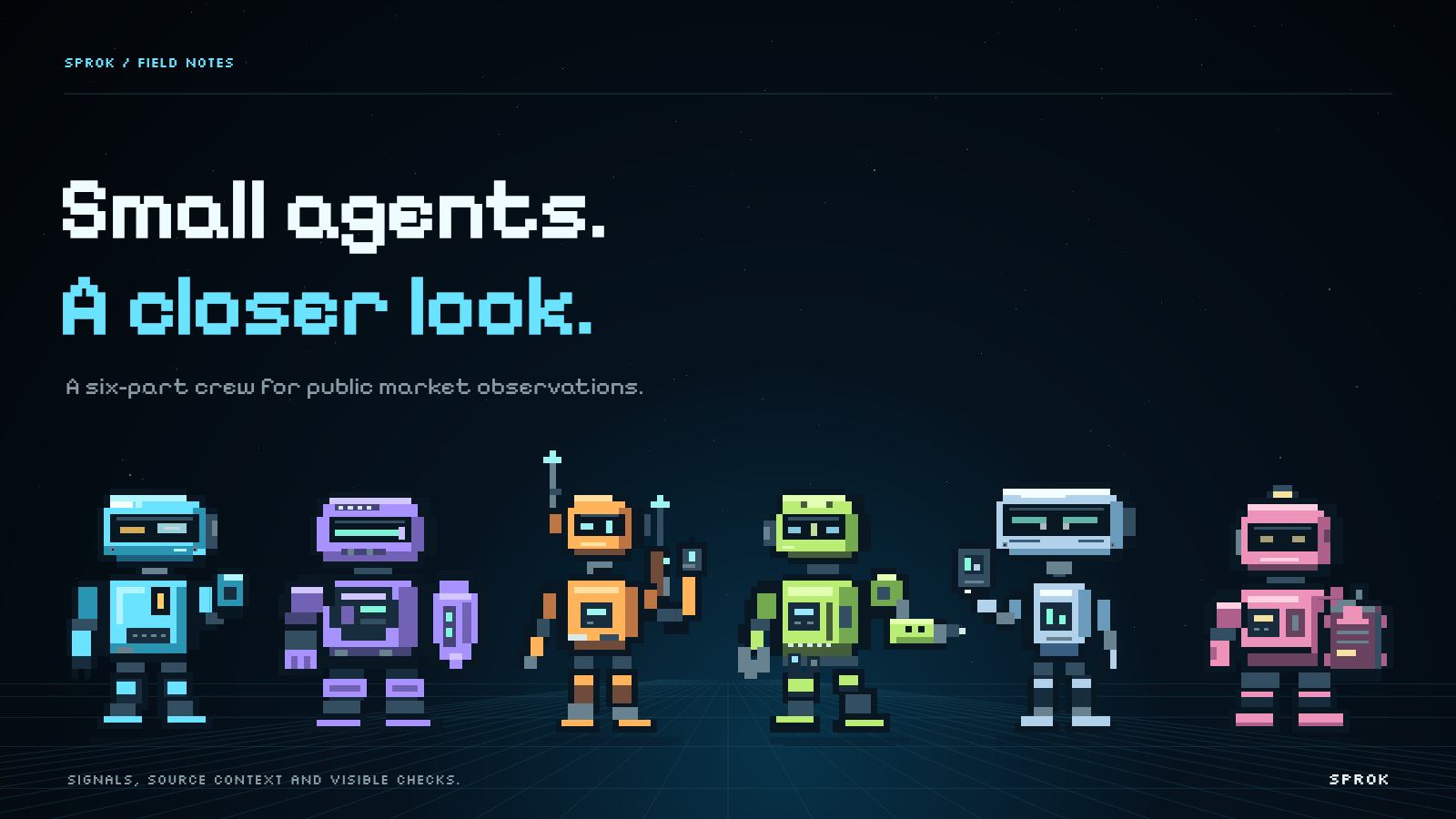
A price tells you where a market is trading. It does not explain the activity behind it, the recent range, or the gaps in the available data. SPROK brings those questions together in a small crew of pixel operators. Each robot has a defined task and a distinct perspective. Their observations come from public data and explicit calculations you can inspect.
BTC, ETH and SOL receive live Coinbase Exchange quotes through a public WebSocket. The quote and its connection status stay separate from the analytical snapshot. That snapshot uses exchange statistics and closed 15-minute candles, with Kraken as a fallback; its statistics and history remain on the same venue. These are venue-specific readings, not whole-market aggregates. For Solana tokens, including a curated pump.fun-origin selection, SPROK requests indexed DEX Screener pools and chooses the deepest matching pool with the requested mint as its base token.
TRACE watches trend through EMA 9 and EMA 21 on closed major-market candles. A faster average above a slower one describes their current relationship, rather than predicting the next candle. BULWARK adds risk context through Wilder ATR 14, a measure of recent price movement. In token mode, it compares reported pool liquidity with reported market cap when both figures are usable.
PING follows activity. For exchange markets, volume remains in the traded asset's units: BTC volume is BTC, not an invented dollar total. For token pools, it reads reported dollar volume and buy/sell transaction counts. Those counts describe transactions, not unique people. PATCH checks whether the needed fields are present and keeps the selected venue and pool scope visible.
LENS reads Wilder RSI 14 for supported major-market history. Readings at or below 30 and at or above 70 mark commonly watched momentum conditions; neither condition is an automatic reversal or an instruction to trade. Token observations instead use the provider's available short-period price changes. STACK describes structure using the highest high and lowest low of the latest 20 closed 15-minute candles.
Those rolling levels help frame conditional questions: Is price near the recent range boundary? Does activity support a move? How large is recent volatility relative to a proposed invalidation distance? The crew organizes the evidence around those questions. A range boundary is an observed reference, not a promise that price will stop there. Any position-sizing calculation also leaves fees and slippage to account for.
The distinction between the two data paths matters. DEX Screener pool snapshots do not supply the candle history used here for EMA, RSI, ATR or rolling levels. SPROK does not manufacture those indicators for tokens. Calculations use consecutive candles. Insufficient history can leave indicators unavailable; readings are withheld when the latest candle closed over 45 minutes ago. An absent reading stays absent, instead of becoming a reassuring zero.
While the page is visible, Solana pool snapshots are requested every 15 seconds and major-market analytical snapshots every 60 seconds. Provider caching can repeat token readings. This token polling is not a trade-by-trade stream. Major candles may remain cached for five minutes. The live quote connection retries automatically after interruptions and shows its status. A disconnected price is a last received quote, not a fresh tick. Source links, timestamps and JSON exports preserve the context.
SPROK is built for a closer look before a decision. Its six operators are rule-based tools, not a connected language model or an autonomous trading desk. They do not connect a wallet, hold funds or execute orders. The aim is simple: give each market question a clear owner, keep the supporting numbers nearby, and make the reasoning easier to examine.